Public Sector Accounting and Budgeting

Public Sector Accounting and Budgeting


Volumes 7
Issues 23
Articles 127
Authors 226
Article View 89,672
Article Download 37,257
Article View Average 706.08
Article Download Average 293.36
Indexing & Abstracting 12
Reviewers 38


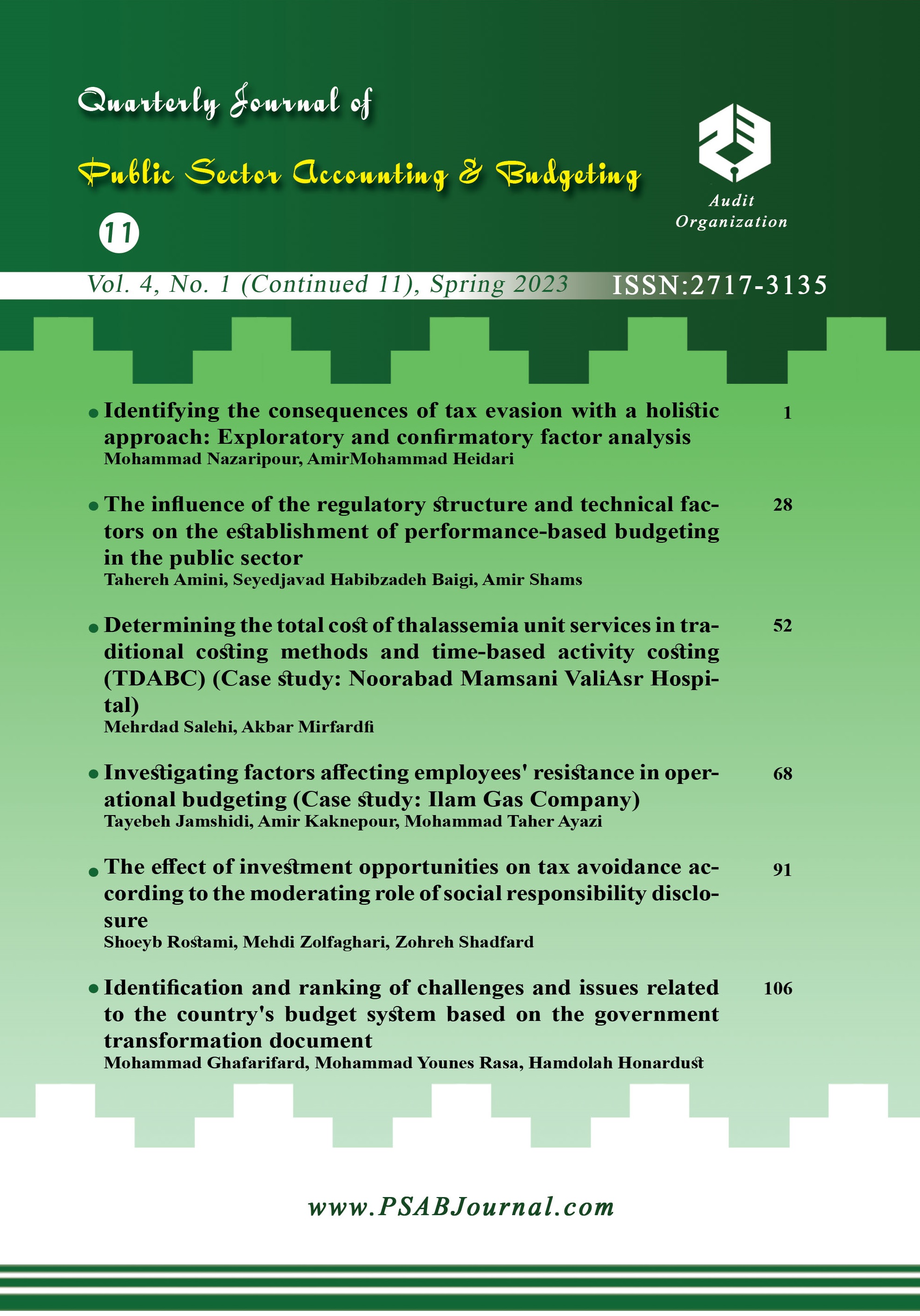
The Quarterly Journal of Public Sector Accounting and Budgeting (PSAB) is a scientific and academic journal aimed to publish scholars’ original and high quality manuscripts and reports in the field of public sector accounting. PSAB adheres to open access policy to accelerate the barrier-free dissemination of scientific knowledge which can result in higher visibility and increased citation for authors' works.

Accounting and financial researches in the public sector, government and executive bodies are examined in this quarterly. PSAB approach is scientific and research and its main view is to develop public sector accounting knowledge, identify public sector challenges and find suitable solutions to improve it.

PSAB is licensed by Ministry of Culture and Islamic Guidance in Islamic Republic of Iran. Also, the journal is published based on the contract number 15188 with the cooperation of the auditing organization. The audit organization is the highest accounting and auditing institution in Iran, which also compiles accounting standards for the public sector of Iran.


Indexed in ISC (Islamic World Science Citation Center) and DOAJ

  •  
  •  
    • Frequency: Quarterly
    • License Holder: Mehdi Faraji with the cooperation of Iran Audit Organization
    • License No.: 87097
    • E-ISSN: 2717-3135
    • Start: Autumn 2020
    • Language: English & Persian
    • Indexed and Abstracted: Yes
    • Review Process: Double Blind Peer Review
    • Acceptance Rate: 29%
    • Open Access: Yes
    • Average Review Time of Articles: 6 Weeks
    • Method of Reference Writing: APA 
    • Plagiarism Check: Yes (Hamyab Site)
    • Article Charges (For Iranian Authors):
    • 1.500.000 IRT for Reviewing, Editing and Publishing
    • English articles will be published free of charge if accepted.
    • Contact Email: Psabjournal@gmail.com

Keywords Cloud

  • Public Sector
  • Public Sector Accounting
  • budget
  • Accrual Accounting
  • Budgeting
  • Accountability
  • New Public Management
  • Artificial intelligence
  • Tax Avoidance
  • Financial Reporting
  • Performance-Based Budgeting
  • GASB
  • Tehran Municipality
  • Operational Budgeting
  • Audit Quality
  • Financial Supervision
  • corporate social responsibility
  • Corporate Governance
  • COVID-19
  • Tax Gap
  • Business strategy
  • Meta-analysis
  • Public sector accountants
  • accrual basis
  • Sustainability Reporting
  • Earnings Management
  • Public Value
  • Local Government
  • hierarchical analysis
  • Human factors
  • financial crisis
  • Law of balanced use of the country\'s facilities
  • Public sector auditing
  • Spatial Econometrics
  • Efficiency
  • Institutional theory
  • sustainable development
  • Public sector financial reporting
  • Environmental Factors
  • structural equation modeling
  • Financial Sustainability
  • Inflation
  • Tax Compliance
  • organizational performance
  • Quality of Financial Reporting
  • Blockchain
  • Financial Accountability
  • Machine Learning
  • Tehran Stock Exchange
  • Financial governance
  • Accounting
  • Financial Distress
  • Systematic review
  • Comptroller
  • Public Sector Accounting Standards
  • AASB
  • Vision setting
  • Government financial statements
  • Performance Measurement and Management Systems (PMMS)
  • Financial System
  • Non-executive director
  • Functional budget
  • universities
  • data security
  • Disclosure
  • Annual profit announcements
  • Industry Expertise of Audit Partners
  • Labor force participation
  • Drivers of Accountability
  • Measurement
  • Capital Market
  • \"Currency\"
  • Responsibility of accountability
  • Trust
  • Control of accounting
  • Strategic Planning
  • IGASs
  • Government finance
  • Tax technology
  • Conceptual Framework
  • Earnings persistence irregularity
  • Public sector ownership
  • Optimal decision making
  • holistic approach
  • Integrated Reporting
  • Sustainability indicators
  • Administrative Reforms
  • Government transformation document
  • Cash Holding
  • Audit efficiency
  • Public Revenue
  • experts
  • digital economy
  • \"Securities\"
  • Inventory management
  • Efficiency of investment in labor
  • Accounting Information
  • Financial Derivatives
  • Financing
  • Sustainable Income
  • Budget-based planning
  • Modern tax system
  • Financial Reforms
  • Governance and social institutions
  • Forward-looking information
  • covid 19
  • Intolerance of Ambiguity
  • Bitcoin and Ethereum
  • Budget distribution
  • legitimacy
  • Discrimination in budget distribution
  • behavioral skills
  • Negative effects
  • Expectation Gap
  • Electronic Government
  • Acceptance of operational budgeting
  • Risk disclosure
  • Financial Independence
  • Profitability
  • Accounting of refinery
  • Supreme Audit Court
  • E-Government
  • Income inequality
  • Disclosure Quality
  • Voluntary carbon disclosure
  • Government actions
  • growth
  • Modern public Management
  • Management Accounting
  • crisis management
  • Financial statements readability
  • Horizontal and vertical trust
  • Uzbekistan
  • International Financial Reporting Standard
  • Ilam Gas Company
  • Value-based asset- liability management
  • Employee resistance
  • \"Economic Growth\"
  • Political communication
  • Legitimacy theory
  • optimization
  • operating assets
  • fuzzy Delphi approach
  • New public financial management
  • Sustainability
  • The Statement of accounting concept
  • Major shareholder ownership
  • Ethical compliance
  • cost accounting
  • Economic Inequality
  • public-private partnership
  • individual characteristics
  • Intrinsic Dynamism
  • Election and appointment
  • Public sector accounting training
  • challenge
  • deficit
  • Financial reporting council
  • Internal Audit
  • Performance base budgeting
  • earnings volatility accruals
  • Operating Cash Flow
  • financial infrastructure
  • Sustainable development goals
  • For-profit and commercial institutions
  • Temporary tax difference
  • Public sector financial management
  • Management Accountants
  • Investment Opportunities
  • Performance of governments
  • Audit Fee
  • financial fraud
  • Post-new public management
  • Governmental development projects
  • Earnings forecasting
  • Transparency and accountability
  • Assets sales
  • Financial Managers
  • Disclosure of Information
  • Laws and Regulations
  • Governmental Accounting Standards Board
  • approaches to combat with corruption
  • Dividend Payment
  • IFRS 9
  • Governmental sector
  • Perceived Behavioral Control
  • Environmental Challenges
  • Islam
  • Budget structure
  • Qualitative characteristics of financial information
  • balance sheet
  • Raw material cost management
  • financial instruments
  • Costing based on time-oriented activity
  • Size of board of directors
  • organizational learning culture
  • Reform of accounting standards
  • stock price changes
  • Performance electronic services
  • Asset generation